 Popcorn Panic
Why multiply gate games are so satisfying
A small group, a ×2 sign and a sudden crowd. Here is what makes that moment feel so good, piece by piece, and how to get more of it.
In this guide
Multiply gate games feel satisfying because they turn a tiny choice into a big, visible result. You pick a gate in about a second, the crowd jumps in size right in front of you, sound and motion confirm it, and the level ends with a finish that shows off everything you built. Short levels and fair difficulty let you feel that loop again and again without it wearing thin.
You have seen it in an ad or played it yourself: a handful of characters run through a gate marked ×2, and a moment later there is a crowd. Nothing complicated happened, yet it feels great. So why are multiply gate games so satisfying, when the idea fits in one sentence?
The answer is not one trick. It is several small design choices stacked on top of each other. This guide pulls them apart, using Popcorn Panic, our own crowd runner, for the details, because we can tell you exactly what the game does at each moment. At the end you will find a few simple ways to get more of that good feeling out of any game in the genre.
Growth you can see, not just a score
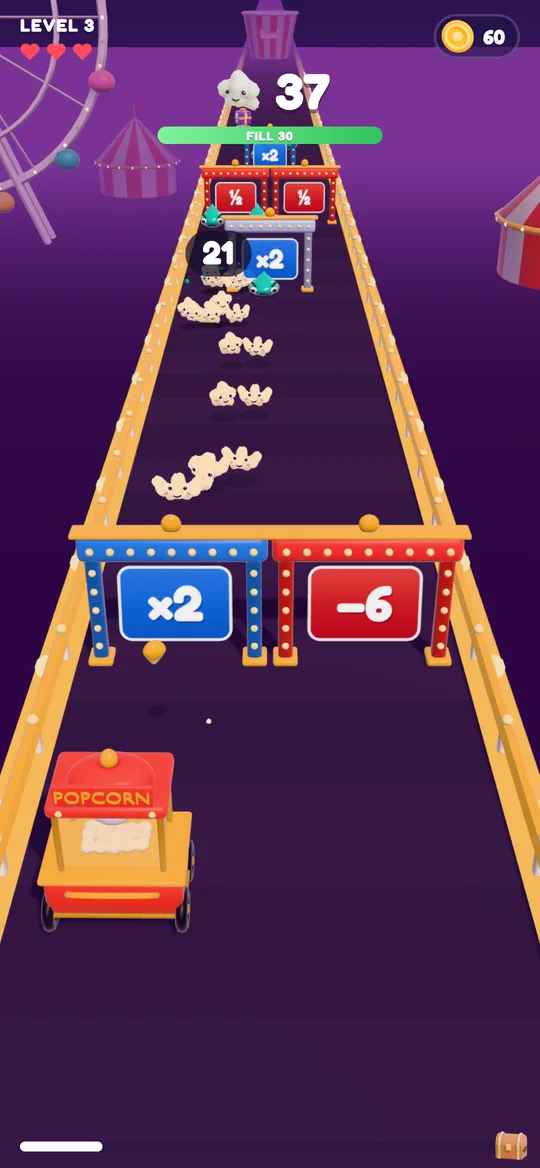
Most games keep score in a corner. A gate game puts the score on the road. Your crowd is the number, and when it doubles, you see twice as many characters running in front of you.
That matters because you never have to read anything to know you did well. In Popcorn Panic, a kernel that goes through a POP gate bursts into fluffy pieces, and the stream on the road gets visibly thicker. One count floats above the crowd and the total sits at the top of the screen, with a Fill bar underneath that shows how close you are to filling the bucket. The picture and the number tell the same story.
Multiplication also grows faster than you expect. Adding feels like a step; multiplying feels like a jump. Two ×2 gates in a row turn 20 into 80, and the second jump is bigger than the first. That is why a single good row can feel like a turning point, and why players remember the moment the crowd "took off". If you want the maths behind it, our add or multiply gate guide shows when ×2 beats a plus sign.
A choice that takes one second
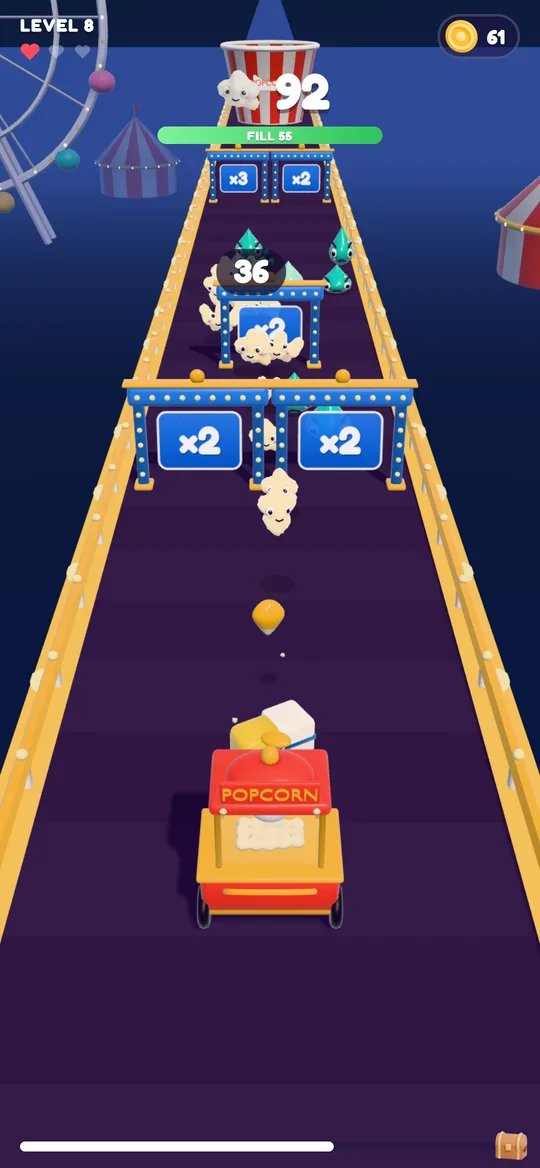
A gate row is a decision small enough to make in a heartbeat, yet real enough to matter. Two signs, one swipe, done. You do not need a tutorial or a menu. You read "×2" against "−6" and your thumb already knows.
That speed is a big part of why multiply gate games are so satisfying. You get the pleasure of choosing well without the weight of a long decision. And because the result arrives a moment later, you know at once whether you were right.
Good gate games also keep the choice honest. In Popcorn Panic the good gates are blue (POP ×2 and ×3, BUTTER +2 to +6, SALT ×2) and the bad ones are red (minus gates and soggy halves). Later levels add moving gates and gates that flip between a red and a blue sign, so the choice stays a choice instead of becoming a reflex. Our Popcorn Panic gates explained guide lists every sign.
Sound and motion that say "yes"
The best moments in a game are confirmed twice: once by what you see and once by what you hear or feel. Gate games lean on this.
Here is what happens in Popcorn Panic when popcorn hits a good gate:
- The gate flashes as pieces pass through, so you know they counted.
- You hear it. Kernels pop, butter makes its own soft sound and salt adds a light patter.
- A ×3 gate gives the camera a small push forward, so the big multiplier feels bigger than a ×2.
- The count climbs above the crowd and at the top of the screen.
Bad gates answer too, just more quietly: red minus numbers float up from the stream so you can see what you lost. Nothing is hidden, and nothing shouts at you for a mistake.
Notice what is missing. By default, Popcorn Panic keeps the screen clean: one count above the crowd, clear gate signs and big chunky popcorn, instead of a pile of combo meters and pop-up words during play. The feedback is there, but it does not crowd out the road.
A finish that shows off your work
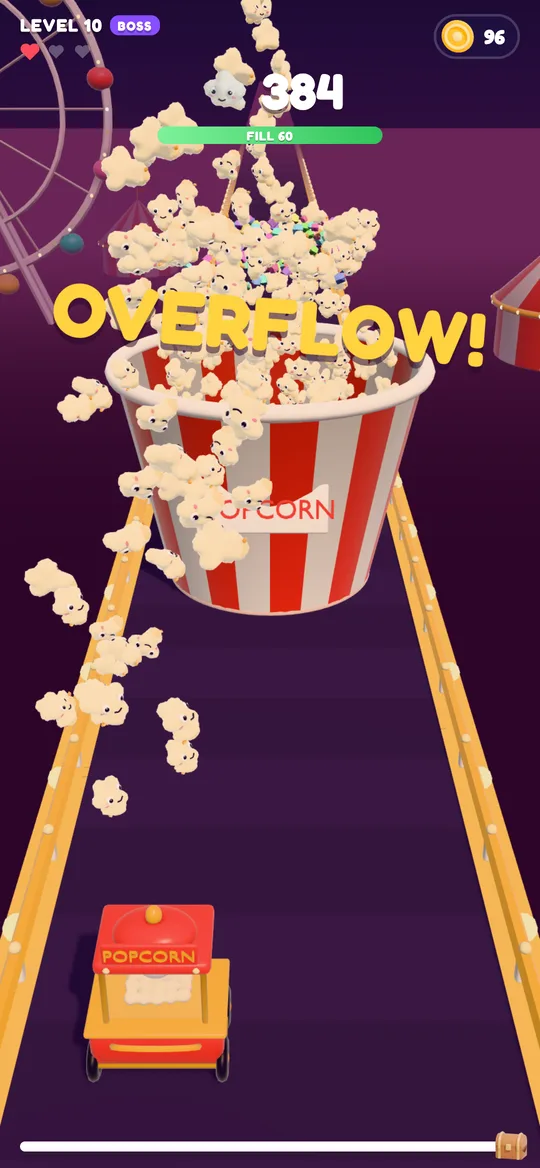
A gate run ends with a payoff. In some crowd runners it is a fight, in others a tower or a finish line. In Popcorn Panic it is a giant striped bucket, and the whole level builds to filling it.
When the bucket fills, the game makes a moment of it. The word OVERFLOW! appears, the action slows for a beat, confetti bursts out and extra popcorn spills over the rim. On a phone you also feel a short buzz. Everything you did on the road comes back to you in one picture.
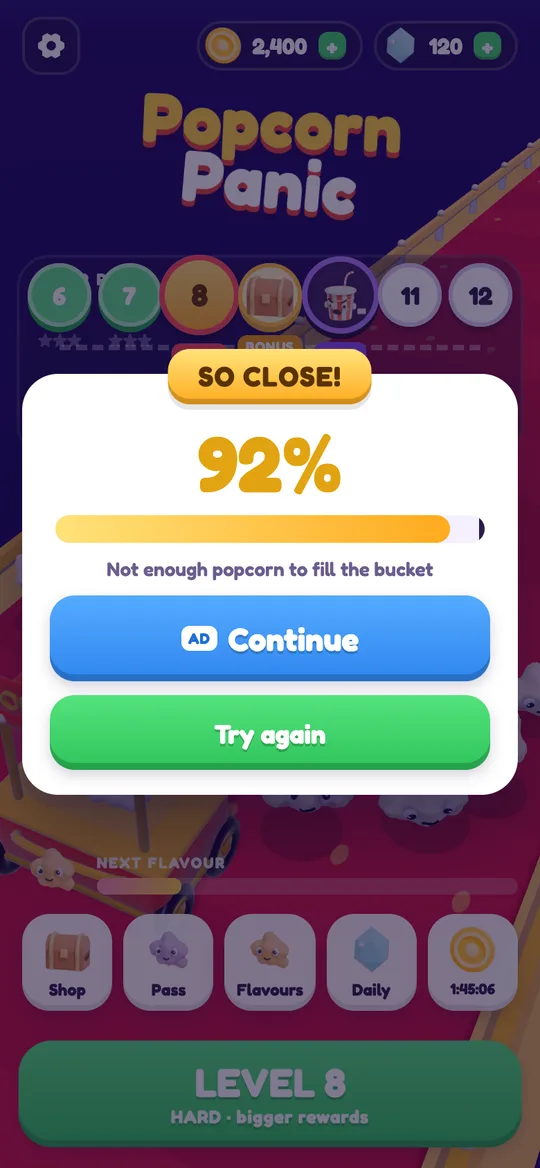
Losing has a shape too. If you reach at least three quarters of the bucket, the game says SO CLOSE! and shows your percentage. Below that, it says TOO SOGGY! Either way you see how far you got, and you can tap Try again straight away. That clear "almost" is part of why one more level is so tempting.
Short levels and fair difficulty
Satisfaction wears off if every level feels the same, or if levels feel unfair. Gate games handle both with rhythm.
Levels are short, so a good moment is never far away. In Popcorn Panic every level is a little harder than the one before. Every 5th level is HARD with bigger rewards, every 10th is a boss fight against the Big Gulp, and a calmer breather level follows each spike. After each boss you get a bonus popcorn rain. The crowd count tops out at 999 per level, so even the biggest runs stay readable on screen.
That rise and fall keeps the good feeling fresh. A hard level makes the next easy one feel generous, and a boss win feels earned because you had to plan for it. The coins you win go into upgrades (Start crowd, Pop speed and Pop power), so your cart grows with the challenge instead of falling behind it.
How to get more out of gate games
You can make these moments land more often with a few habits:
- Choose early. Pick your gate as soon as the row appears, then hold steady. A whole crowd through one gate feels better than half a crowd through two.
- Watch the count, not just the gates. Seeing the number jump after a good row makes the next choice easier.
- Keep the multipliers in a row. Two multipliers back to back grow your crowd far more than one multiplier and one detour.
- Treat "so close" as a hint. A high percentage usually means one row went wrong. Replay and fix that row.
- Take the breathers. After a HARD level or a boss, enjoy the easier level instead of rushing it.
For the basics of the genre, read what is a crowd runner game, and for steering habits that keep every piece inside the gate, see how to keep your crowd together.
FAQ
Why do multiply gates feel better than plus gates?
A plus gate adds a fixed amount, while a multiply gate grows with your crowd. The bigger your group, the bigger the jump, so a ×2 late in a level often adds far more than any plus sign could.
Are gate games just luck?
No. The gates are written on the signs, so every row is a choice you can read. Steering early and keeping your crowd in one stream matter more than luck in most gate games.
Why do gate game levels end with a big finish?
The finish turns your whole run into one result you can see. In Popcorn Panic that is the giant bucket, which overflows with popcorn when you fill it.
Does Popcorn Panic show lots of effects on screen?
It keeps play clean on purpose: one count above the crowd, clear gate signs and a Fill bar. The big words are saved for moments like OVERFLOW! and power-ups.
Can I play Popcorn Panic without the internet?
Yes. Popcorn Panic plays offline. The internet is only used for ads, and the game is coming soon to Google Play.